




Stories about China

Hong Kong’s homegrown security law seeks to define ‘state secrets’ along China’s legislative line
The definition of state secrets covers secrets in major policy decisions, military, foreign affairs, economic and social development, technological and scientific development, national security operations, HK and China relation.

Hong Kong kickstarts local national security law legislation with explaining and rebuttal teams
Chief Executive John Lee: Hostile forces would engage in propaganda work, especially online, to smear and distort the legislation.

Why did Taiwan impose a five-year visa ban on an influential mainland Chinese dissent journalist?
Wang Zhian, a Tokyo-based mainland Chinese journalist, mocked the Taiwanese election campaigns on a comedy talk show, sparking online backlash. He was then banned from entering Taiwan for five years.

Hong Kong embraces televised confessions of political prisoners
"It is the same kind of propaganda: the court’s ruling is justified and reasonable, and look, he himself confessed it. How would the National Security Judge wrong a good person?
New policy requires Chinese influencers to display their personal information on Weibo
Popular mainland Chinese Weibo users must display their real identities, including names, gender, IP locations, and professional and educational background, on their account page starting at the end of October.

‘I can see the entirety of the sky now’: Australian journalist Cheng Lei is now free
"Tight hugs, teary screams, holding my kids in the spring sunshine. Trees shimmy from the breeze. I can see the entirety of the sky now! Thank you Aussies."

Confessions from a Chinese censorship worker
A Chinese censorship worker discusses her workday, colleagues, and hatred for the Chinese censorship system.

Australian journalists imprisoned in China anxiously await diplomatic breakthrough
Australian novelist Yang Hengjun has been awaiting the verdict on his case in China for more than two years after being accused of spying. Now he fears he may die in detention

‘I haven't seen a tree in three years’: An Australian journalist’s prison letter from China
"I miss the sun. In my cell, sunlight shines through the window but I can stand in it for only 10 hours a year. ... Most of all, I miss my children."

Hong Kong artist in exile in Taiwan uses protest art to resist Beijing's attacks on freedom in the region
For Hong-Kong political activists, journalists, and artists, Taiwan remains the last free Chinese-speaking society where they can operate. Global Voices interviewed Hong Kong artist Kacey Wong who moved to Taiwan in 2021.

What is ‘soft resistance’? Hong Kong officials vow to take a hard line against it, but provide no definition
Hong Kong officials have vowed to take a hard line against “soft resistance” but failed to define the term. HKFP tracks the term's usage and quotes views from legal scholars.

Hong Kong’s homegrown security law, Article 23, is back in the spotlight
An attempt to pass the city’s own security law collapsed in 2003 under the weight of mass protests. This time, public opposition is likely to be muted.

Hong Kong court rejects government application for ban on pro-democracy protest song
The judge believes that perfectly innocent people might refrain from engaging in lawful acts involving the song for fear of trespassing the injunction.

Can Taiwan become a hub for journalists fleeing mounting authoritarianism in Asia?
Taiwan is rated as one of the freest societies in Asia, but are the Taiwanese authorities ready to turn the island into a welcoming and safe haven for journalists fleeing authoritarianism in their home countries in Asia?

Commentators discourage extending national security crackdowns to ‘soft resistance’ in Hong Kong
The government is considering clamping down on “soft resistance” when drafting the local version of National Security Law (HK-NSL).

The Great Leap Backwards of media in China
To understand the nuances of censorship, state violence, resilience and journalistic courage in China, Global Voices interviewed Cédric Alviani, head of the Taiwan-based office of RSF for East and Southeast Asia.
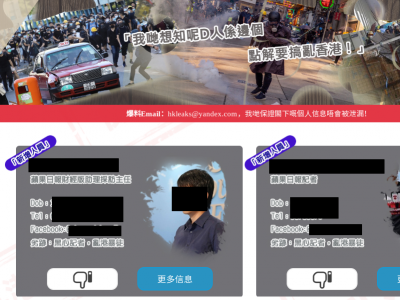
A forensic investigation finds a site that doxxes Hong Kong activists and journalists is likely backed by Beijing
Toronto-based Citizen Lab finds circumstantial evidence that suggests the campaign operators held links to mainland China.

Hong Kong pro-democracy exiles not intimidated by China’s arrest warrants and bounties
"Trying to spread fear at home, abroad, and travelling in between. Further incentive to fight for the #rights, #freedom, and #democracy that we deserve"

Digital rights activist groups urge tech giants to defend against Hong Kong’s injunctions against protest anthem
More than 24 human rights and digital rights groups believed that the injunctions, once granted, would have a “disastrous effect” on freedom of expression and information access, with global implications.

Hong Kong Court asks: Who are the defendants of the protest anthem injunctions?
"Even if [the injunction] successfully restrained Google, it would only prohibit its circulation within Hong Kong. The SAR government has to apply an injunction in the U.S.A to take down the videos globally […]"